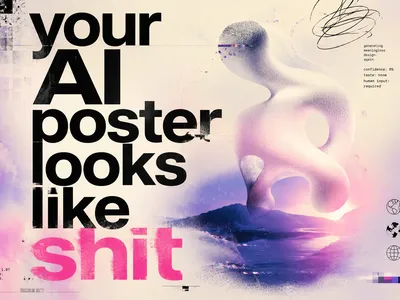
Your AI Poster Looks Like Shit (And Customers Think It's A Scam)
As a creative, this hurts my industry. As a consumer, it hurts my eyes. Neither of those is an argument you have to care about, so let's talk about the one that costs you money.
05 Aug 2026
For anyone using LinkedIn to actually build something, it has the potential to chip away at the machine that feeds your business.
Blog
LinkedIn has sneakily handed its users a new superpower: the ability to glance at a post, decide it reeks of ChatGPT nonsense, and flag it as "Seems like AI slop."
For most people, it's a bit of harmless social media housekeeping, but if you're a marketer or a business owner building a brand, it's worth understanding exactly where the line sits.
The headlines have been a little vague with it. This isn't a new emoji reaction sitting next to the "like" and "celebrate" options. It's a report flag, tucked inside the three-dot menu on any post. If you tap it, three things happen in quick succession: The post disappears from that person's feed, LinkedIn's AI-detection models get a training signal to learn from, and the post author gets a heads-up about it in their analytics dashboard.
It's also not a one-off gimmick, it's one piece of a much bigger anti-AI push. LinkedIn is retiring its "Enhance your post" AI writer in favour of a lighter proofreading tool designed to tidy up your grammar without flattening your voice. Chief Product Officer Hari Srinivasan put it bluntly, calling AI slop "a top priority" for the platform.
The numbers are indeed grim. AI-detection firm Pangram found that more than 40% of long-form LinkedIn posts are now fully machine-generated, enough that even Substack's CEO recently used LinkedIn as a cautionary tale of what he didn't want his own platform to become.
If a casual Linkedin user gets flagged, it’ll sting their ego and nothing much else. But for anyone using LinkedIn to actually build something, it has the potential to chip away at the machine that feeds your business.
For a marketer or a fractional CMO, Linkedin is a shopfront and referral engine rolled into one. For a business owner or founder, it's often the first place a prospective client, hire, or investor "meets" you and decides whether you're the real deal. And for everyone else, it's your professional reputation.
Now, put that next to how the button works. Every flag trains LinkedIn to dial down the reach of the content that pattern-matches to AI-slop, so there's a direct cost: fewer people will see you. But, it’s the reputational cost that is the one that really bites - once someone mentally files you under "posts AI sludge for engagement," no amount of algorithmic reach will win them back.
Most of us are using AI somewhere in our day-to-day lives now, whether that be to fill a blank page, tidy a clunky sentence, or get a first draft out the door. There's nothing wrong with that. So, before anyone gets defensive, understand what this button is actually policing.
It's not "AI versus no AI." It's slop versus not slop. Those are two different things.
Srinivasan himself admitted that AI-slop is hard to pin down and the definition of it keeps shifting, but you know when you spot it. It's a post with a hot take on yesterday's news that contains absolutely zero human opinion or emotion, or the "This changes EVERYTHING" opening line followed by five bullet points a search engine could have written.
AI is brilliant at helping you draft, tighten, and structure, but the moment you let it decide what you’re thinking, you've crossed into slop territory.
The slop radar also applies to design, and that battle is already well underway. You all know the posts - the "flyer" someone very obviously knocked out in ChatGPT and dropped straight into their feed. 404 Media christened it the "ChatGPT flyer pandemic", and once you recognise the look, you can't unsee it.
I dug into this in a recent piece on why your AI-generated poster quietly reads as a scam, and the short version holds up: when every local business is prompting the same tool, every single design looks like every other design. No defined brand, no differentiation, nothing to set you apart from the competitor. The average scroller's brain has now filed that garish look under "don't trust this." So an AI-slop design does the same reputational damage as a slop post.
The fix isn't to stop using AI. It's "sound like a human who has something to say." Here are a few habits to keep you out of the firing line:
The AI-slop button is really just a filter. It separates the people using AI to amplify a real point of view from the people using it to avoid having one. If you're in the former camp, then this is good news.
At Cemoh, we connect businesses with experienced marketers and fractional CMOs who bring strategy, judgment, and a voice that sounds like a real human, not a content mill. So, whether you're a business owner who wants marketing that actually sounds like you, or you’re a marketer keen to build up a good reputation, talk to the team at Cemoh. And if you're weighing up your options, here's how a fractional CMO stacks up against a full-time hire.
Expert Contributor

Jess Aumonier
Content Strategist
A visual communication expert who uses creativity to drive commercial success and engage audiences.
View ProfileHere are some suggested articles that are closely related to this post
As a creative, this hurts my industry. As a consumer, it hurts my eyes. Neither of those is an argument you have to care about, so let's talk about the one that costs you money.

Here's the paradox of the AI content era: yes, there is more content than ever. But there is also less distinctive content than ever.

When production becomes free and infinite, production can no longer be the thing that makes your brand distinctive.

Explore how a fractional CMO Australia can elevate your marketing strategy, reduce costs, and drive growth for your business. Find out more now!

Need a marketing consultant for small business? Discover expert tips and guidance to boost your small business marketing success today.

Thinking about outsourcing social media manager duties? This guide covers how to find, hire, and manage the right expert for your Australian business.