AI Can Generate Anything. That's Why Craft Matters Again.
When production becomes free and infinite, production can no longer be the thing that makes your brand distinctive.
22 Jul 2026
As a creative, this hurts my industry. As a consumer, it hurts my eyes. Neither of those is an argument you have to care about, so let's talk about the one that costs you money.
Blog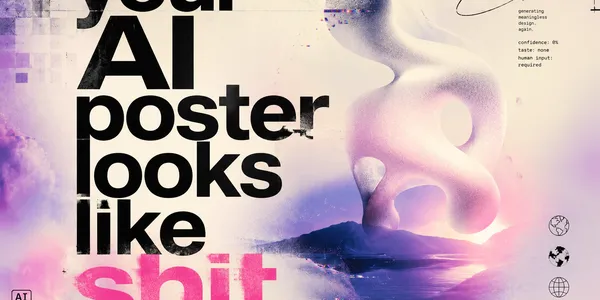
Last week, two recruitment ads turned up in my facebook feed within about a minute of each other. Both were unmistakably ChatGPT-generated (yes, we can all spot it these days and any business owner who thinks otherwise has lost their mind). And my immediate reaction, well before I'd read a single word was: that's a scam.
One of these ads was from a real and genuine NDIS disability services organisation, advertising real jobs.
I want you to sit with that for a moment, because it is the most damning thing I can tell you about AI-generated marketing material. My brain (and I promise you it's not just my brain) has now filed that garish visual style under ‘fraud’. Real organisation, real roles, real people who needed those roles filled, and the very first signal it sent to a marketer with twelve years of design experience was ‘don't click this’.
A couple of weeks ago, someone on my Linkedin feed posted a grid of sixteen event flyers they'd screenshotted from their local community. Animal rescue, a local pub, a market, a small business grand opening, a charity fun run. Sixteen different businesses, sixteen different audiences, sixteen completely unrelated events.
Every single one was ChatGPT-generated. And every single one looked like the same flyer.
The same chunky, slightly-melted 3D lettering with flourishes at either end. The same mystery objects floating in the background for no reason. The same layout crammed to the very edges with text that dissolves into complete gibberish if you look at it for longer than two seconds. Sixteen small businesses, each of them convinced they'd just saved a few hundred bucks, all producing the exact same piece of visual noise.
This isn't a niche problem in one American town’s Facebook groups. Scroll your own local feed - Brisbane, Sydney, wherever you are, and count the trivia nights, markets, recruitment campaigns and school fundraisers carrying that unmistakable synthetic sheen.
Even the animal rescue community has had enough. The Rescue Collective recently posted a pretty blunt message to rescuers and wildlife groups telling them to stop using AI for their posters and ads outright. When a sector running almost entirely on donated time and goodwill is publicly asking its own people to knock it off, you're not looking at a trend. You're looking at a credibility emergency.
As a creative, this hurts my industry. As a consumer, it hurts my eyes. Neither of those is an argument you have to care about, so let's talk about the one that costs you money.
A Harris Poll released around Cannes Lions this year found that a whopping 63% of consumers said they'd be far less likely to buy from a brand using AI-generated ads, and 73% said they'd be less likely to trust an ad they suspected was AI-made. Nearly three-quarters of the people who see your poster are dialling down their trust in you before they've started reading.
Klaviyo surveyed 8,000 consumers across eight countries, Australia included, and found that just 7% said visible AI-generated marketing made them trust a brand, while 31% said it made them trust the brand less. That's a four-to-one loss ratio on the single thing your marketing exists to build.
And it's accelerating. Fractl's 2026 research found the share of consumers who say heavy AI use would decrease their trust in a favourite brand doubled from 20% in 2025 to 40% in 2026, with Gen Z the harshest at 54%.
There would be some justification for all this if using AI and saving money on a designer produced better ads and flyers. But it doesn't. You save $300, and in exchange you tell a huge chunk of your audience that you either couldn't be bothered or couldn't afford to do it properly. Both are terrible things for a local business to communicate.
Two or three years ago, spotting an AI image actually took effort. You'd have to count the fingers, check the text, look for the weird melty bits.
Nobody needs to do that now. The audience has been trained by sheer over-exposure. They've seen ten thousand of these things and they clock it instantly and subconsciously, the same way you can identify a hideous Comic Sans sign from across a car park without reading a word of it.
That's the shift that's now catching small businesses out. AI detection used to be a game for designers and creative nerds. Now, it's ambient, involuntary and fast. And once an audience can identify this on sight, it carries a meaning. Right now that meaning is some blend of cheap, lazy, didn't care enough - and, as those recruitment ads proved, probably a scam.
It's got so bad that brands are now hiring people specifically to make behind-the-scenes content proving their ads were made by humans. "We made this ourselves" has become a selling point.
I wrote about this in a previous piece, but it explains the sixteen-flyer grid so perfectly it's worth repeating.
Generative models don't invent. They predict. They're trained on everything on the internet that already exists, and when you prompt them, they hand back the statistical middle of all of it. The most probable pixel. The most predictable arrangement of a "vibrant event poster." So when sixteen businesses independently ask for a ‘vibrant event poster’, sixteen near-identical event posters isn't a bug, it's exactly what the machine was built to do.
This produces an absurd outcome. The entire purpose of a poster or flyer is to stand out in a crowded feed. AI produces the average of everything ever made. You cannot stand out using a tool engineered to produce the middle.
Worse still, the aesthetic is now culturally coded. Two years ago that neon-glow style read as "modern." Today it reads as "AI." You're not just failing to differentiate, you're actively branding yourself as the lazy business that took the shortcut.
Here's a development that really worries me, and it's the reason I don't think this problem sorts itself out naturally.
A bloke recently bought a business from friends of mine. He told the staff he wanted to go hard on new marketing and bring the business into the 21st century. Sensible instinct. So he did the right thing and asked a designer friend to produce a flyer.
The flyer turned out to be ChatGPT-generated.
He thought it looked absolutely fine. He thought it would do the trick. He'd done exactly what you're supposed to do - he asked who he thought was a professional, and the professional handed him a prompt result with an invoice attached.
That business is now going to blend into every other small business in town using the same slop. No identifying brand. No structure to the material. No cohesive messaging. Absolutely no way to differentiate itself from the competitor three doors down.
When people passing themselves off as designers are producing this stuff, the average business owner has no hope of telling the difference. So if you're commissioning creative work, you now have to ask questions you never used to need:
None of this is about gatekeeping. It's about knowing what you're paying for. If you're going to spend money, spend it on someone doing the actual work! Whether that's an experienced graphic designer or a vetted freelance marketer.
Set the AI argument aside for a second, because most of these flyers would fail a first-year design crit regardless of who or what made them.
I've written before that design isn't a matter of taste, it's a matter of function. A poster has exactly one job: communicate the critical information instantly, from a distance, to someone who is not trying to read it.
Look properly at one of these AI flyers and check whether it does that job.
A badly made human flyer with clear information, one readable typeface and some breathing room will outperform an AI flyer with garbled text every single time. Communication beats decoration. It always has.
Most small businesses aren't choosing between a designer and AI. They're choosing between AI and nothing. Nobody has thousands of dollars sitting around for a Saturday market stall.
But "I can't afford a designer" and "AI is my only option" are two separate statements, and the second doesn't follow from the first. Here's what you can actually do:
Learn one tool properly. Canva has become genuinely capable, and plenty of working professionals now use it daily. Ignore the AI features and use it as a real layout tool. Learn text hierarchy, alignment and negative space and you'll produce something specific to you. Ironically, the tool people once called "cheating" is now the more respectable option.
Photograph your own stuff. A slightly imperfect photo of your actual venue, your food, your staff will out-convert a mutated synthetic image every time, because it's evidence that the thing you're advertising exists. It's the single biggest advantage a local business has, and AI cannot replicate it.
Skip the poster entirely. Pull out your phone and record thirty seconds of yourself explaining what's on and why people should come. It costs nothing, looks like nobody else's content, and does the one thing a generated flyer never can: proves there's a human behind the business.
Build one simple template and reuse it forever. Consistency does more for recognition than novelty. One decent layout used every week beats fifty flashy one-offs sharing no DNA.
Or get the strategy right first. If money's tight, spend it on thinking rather than production. Knowing precisely who you're talking to and what you want them to do is worth more than any visual. A marketing consultant or brand strategist can sharpen that in a session or two, and Cemoh offers a free advisory session if you want to test the water.
None of these options require thousands of dollars, and all of them produce something much more distinctive than a prompt.
While small businesses rush toward AI-generated creative to try and look more professional, some of the biggest brands on earth are sprinting the other way and making a virtue of it.
Aerie, Equinox and Almond Breeze all ran campaigns in early 2026 explicitly calling out AI slop, and Dove pledged back in 2025 never to replace real people with AI in its advertising. These are companies with the budget to generate anything they like, publicly choosing not to. Not out of sentimentality about the craft, but because their research told them exactly what every survey above is telling you.
Meanwhile the AI-first attempts keep face-planting. Coca-Cola's generative Christmas ads, Toys 'R' Us's Sora film, Valentino's handbag campaign - all with enormous budgets, with best-in-class agencies, full access to every tool going, and the internet dismantled all of them in a day.
The gap this opens is enormous, and it's in your favour. When almost everyone in your category is producing the same synthetic rubbish, being visibly, obviously, unmistakably human becomes the cheapest differentiator available to you. A slightly wonky poster that someone in your business actually made now reads as authentic rather than amateur.
That's a genuinely rare thing in marketing: an advantage available to the businesses with the smallest budgets.
In my last two pieces I landed on two questions. First: not "do you like it?" but "does it work?" Then: "could anyone else have made this?"
Here's the third, and for AI-generated flyers it's the brutal one: "Would I trust this?"
Not "is this good enough." Not "will this do." Detach yourself from your business owner head and ask yourself, would you look at this and believe there is a real, competent, functioning business behind it?
A poster isn't decoration and it isn't a box to tick. It's a piece of persuasion aimed at someone who owes you nothing, and has been trained by a thousand scams to distrust anything that looks synthetic. If a legitimate disability services provider can trip that alarm in half a second, so can you.
Your audience isn't stupid. They can tell. And increasingly, they're telling you.
Jess Aumonier is a brand and design expert, and the Creative Content Marketing Lead at Cemoh, Australia's fractional marketing network, connecting businesses with experienced fractional CMOs and marketing professionals. Find out more at cemoh.com.
Expert Contributor

Jess Aumonier
Content Strategist
A visual communication expert who uses creativity to drive commercial success and engage audiences.
View ProfileHere are some suggested articles that are closely related to this post
When production becomes free and infinite, production can no longer be the thing that makes your brand distinctive.

Need a marketing consultant for small business? Discover expert tips and guidance to boost your small business marketing success today.

What is digital marketing consulting and how does it work? We explain what a consultant does, why you need one, and how to hire the right partner in Australia.
Here's the paradox of the AI content era: yes, there is more content than ever. But there is also less distinctive content than ever.
Explore how a fractional CMO Australia can elevate your marketing strategy, reduce costs, and drive growth for your business. Find out more now!
Finally, a practical marketing strategy for small business owners in Australia. No jargon, just real-world advice to help you connect with customers and grow.