
The Latest Trends in Ad-Hoc Marketing, Design, and Advertising
Marketing and design are changing fast and freelancers need to keep up. From AI tools to remote work, 2025 is full of new ways to work smarter and stand out.
08 Aug 2025
AI is revolutionising marketing, from hyper‑personalisation and predictive analytics to content automation and workflow optimisation. This blog shows consultants how to leverage AI ethically, stay ahead of trends, and build careers in an AI‑powered w
Blog
AI is now a foundational tool that elevates strategy, efficiency, and creativity in marketing. For marketing professionals and marketing consultants, embracing AI means delivering stronger results, winning new clients, and future‑proofing your expertise. Let’s explore its role in modern marketing, and why consultants who harness it will lead the pack.
For consultants, AI tools unlock capabilities previously reserved for enterprise budgets, everyone can now deliver hyper-personalised campaigns and performance-driven strategies.
Modern AI segments customers by behaviour and preferences in real time, enabling tailored messaging, offers, and journeys. Adobe, Salesforce, and others embed predictive lead scoring, sentiment analysis, and automated workflows in CRM platforms.
Generative AI now handles ad copy, visuals, slogans, and content at scale. Agencies like WPP deploy proprietary platforms for slogan and video generation, while Adobe’s agents automate end-to-end marketing tasks. Meta’s AI-powered ad flow handles strategy, creative and optimisation, boosting conversion by around 5% and projecting billions in ad revenue growth by 2030.
AI tools help identify keywords, optimise blog structure, auto-generate outlines, and optimise content continuously for human readability and search performance. While 74% of webpages use AI-generated content, 97% of organisations manually review it to ensure quality.
Algorithms process big data to forecast trends, model campaign outcomes, and uncover insights. Neural networks used for marketing analysis, customer segmentation, and product forecasting have evolved into decision-support systems that underpin strategy.
AI-driven frameworks, in B2B and B2C, now generate culturally relevant narrative ads at scale using retrieval-augmented generation and persona-based targeting, without A/B testing risk. This enables storytelling that resonates deeply and adapts instantly.
AI-generated influencers and synthetic visuals can boost reach, but risk damaging consumer trust when lack of transparency leads to backlash. Vogue’s use of AI models saw subscription loss from critics who felt AI undermined the emotional authenticity of fashion storytelling.
Language models can generate biased messaging, especially across demographic groups, creating unfair communication outcomes unless mitigated using bias detection and validation pipelines.
Overclaiming AI capability without substance erodes brand credibility and may attract regulatory scrutiny. Transparency is needed to avoid “AI washing”, the overuse of AI buzzwords with minimal actual impact.
Data privacy, intellectual property, and regulatory rules (especially in Australia’s privacy policy and consumer law) must inform AI strategy and deployment protocols.
Use AI for ideation and execution, but layer in client and creative review. For example, generate draft content with AI, then personalise tone and brand context manually.
Many teams lack formal training, 54% cite absence of gen AI upskilling as a barrier. Workshops, internal standards or partnering with tech providers helps bridge this gap. Marketing Strategists looking to grow in this field can also explore AI-focused marketing jobs that demand hybrid skills.
Run controlled tests to evaluate ROI, rather than chasing novelty. Cannes marketers emphasise balancing experimentation with measurable outcomes and trust building.
Disclose AI use where appropriate (e.g. “created with AI assistance”), articulate its role to clients, and avoid overpromising.
In Conclusion
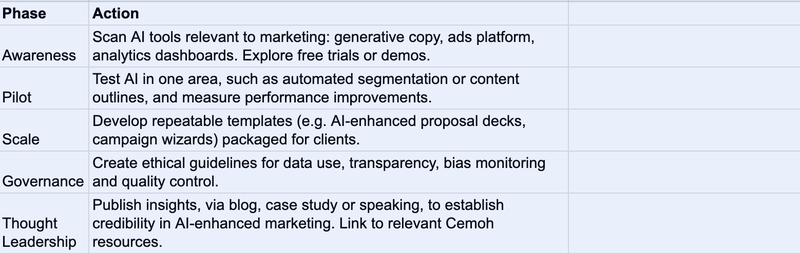
AI is reshaping marketing, from content creation and personalisation to strategy and client acquisition. Smart adoption, not hype, leads to better results, trust, and enduring relevance. Consultants who build workflows that integrate AI ethically and strategically can unlock dramatic efficiency, creative range, and credibility.
Join Cemoh to access guidance, certified tools, and a community of forward-thinking consultants integrating AI for impact. Elevate your consultancy in an AI‑powered marketing landscape.
Here are some suggested articles that are closely related to this post
Marketing and design are changing fast and freelancers need to keep up. From AI tools to remote work, 2025 is full of new ways to work smarter and stand out.

If your marketing isn’t working, it’s likely misaligned across strategy, execution, channels. This article explores why your strategy might be stuck, outlines actionable fixes, and offers how to gain clarity and momentum, plus how to get help from Ce

AI isn’t replacing SEO, but it is changing how it works. Businesses that use AI-driven insights while keeping content thoughtful and well-written will be in the best position to succeed.

As demand for flexible marketing talent grows, standing out as a fractional expert means clearly defining your niche, showing measurable impact, and building a strong personal brand.

Want to stay visible online in 2025? This guide breaks down exactly what CEOs and business leaders need to know about modern SEO strategy.

Looking to scale your marketing without hiring full‑time staff? This guide outlines how you can leverage fractional leadership, outsourcing, automation and strategic partnerships.