



What Does a Marketing Consultant Actually Do? A Guide for Australian Businesses
Not sure what a marketing consultant actually does? See how they audit, plan and roll out your marketing in the first 90 days, and what affects the cost.
16 Nov 2026
Build a one-page marketing plan for 2027. Set one clear business objective, choose three priorities, set a realistic budget and measure what actually matters.
Blog
A useful marketing plan for 2027 doesn't need to cover every possible marketing activity. It needs to make five things clear: what the business wants to achieve, who it needs to reach, which three activities deserve priority, how much it can spend and how it will measure progress.
You should be able to read the plan in a few minutes and know what the business is doing and why.
There's nothing wrong with research, competitor analysis or a detailed marketing strategy. The problem is when the planning document becomes so complicated that nobody uses it to make decisions.
A business with a small marketing team doesn't need the same planning process as a national organisation with several departments, multiple product lines and a substantial advertising budget.
If the owner is still involved in sales, customer service and operations, the marketing plan needs to be realistic about the time and people available.
A Constant Contact guide to creating a small business marketing plan makes a similar point. It recommends keeping the main plan to one page, choosing a small number of measurable goals and reviewing performance monthly.
The Australian Government's business.gov.au guide to developing a marketing plan identifies the same essentials: understand the target market, set marketing goals, choose appropriate channels, establish a budget and evaluate the results.
Neither approach requires a business to document every social media post or advertising variation in its annual plan.
Think of the one-page document as the place where the important decisions live. Detailed campaign briefs, customer research and channel-specific plans can sit behind it.
Before deciding what to do in 2027, take an honest look at the current year. This doesn't need to become a lengthy review. The aim is to understand where customers came from, what generated revenue and where the business spent money without seeing much return.
Look at your sales records alongside your marketing reports. Which activities generated actual enquiries? Which enquiries became paying customers? Did existing customers come back? Were some campaigns producing plenty of clicks but very few worthwhile leads?
It's also worth speaking to the people who deal with customers every day. Sales staff and customer service teams often know why people choose the business, what objections they raise and which competitors keep appearing in conversations.
Xero's Australian small business marketing guide makes an important distinction here: marketing isn't just advertising. Product, pricing, distribution and promotion all influence how customers choose a business.
For example, a business might assume its advertising needs improvement when the actual problem is that its prices are no longer competitive or its website doesn't explain the service clearly enough.
Don't automatically carry every existing activity into 2027. Keep what is working, investigate what isn't and be prepared to stop doing things that consume resources without contributing to the business.
Once you've reviewed the previous year, you can start building the plan.
The framework below has five parts. Each one answers a different question, and together they provide enough direction to guide the business throughout 2027.
Start with what the business wants to achieve, rather than what the marketing team wants to do.
“Increase social media engagement” isn't a particularly useful business objective. Neither is “improve brand awareness” unless you can explain what that improvement should contribute to.
A better objective connects marketing to something the business can measure, such as revenue, new customers, qualified enquiries, repeat purchases or market expansion.
Imagine an Australian commercial maintenance business that wants to win more recurring contracts in 2027.
Its objective might be:
Win 12 additional recurring commercial maintenance contracts by 31 December 2027.
That's much more useful than simply saying the business wants to grow.
Now the marketing activity has a clear purpose. The team needs to reach potential commercial clients, demonstrate why the business is worth considering and generate enquiries that can turn into contracts.
The objective should also be realistic. Look at the current sales figures, average contract value, conversion rate and capacity to take on new work before setting the target.
The business.gov.au guide to setting business goals recommends using specific, measurable and time-bound targets. It's a sensible approach because it gives the business something concrete to work towards and a way to judge whether the plan is delivering.
For most SMEs, one primary objective and perhaps one supporting objective are enough. Trying to improve revenue, customer retention, brand awareness, website traffic and social engagement simultaneously can spread a small marketing budget too thinly.
Decide Exactly Who You're Trying to Reach

Once you know what the business wants to achieve, decide which customers are most likely to help you achieve it.
This is where businesses often make their plans unnecessarily broad.
“We target everyone who needs our services” doesn't give a marketing team much direction. Different customers have different priorities, budgets, buying habits and reasons for choosing a supplier.
Going back to our commercial maintenance example, the business might decide to focus on facility managers and property managers responsible for medium-sized commercial properties across Brisbane and the Gold Coast.
The next step is understanding what matters to those people. Perhaps they want a reliable contractor who responds quickly, provides clear quotes and can handle ongoing maintenance without requiring constant supervision.
Those details should influence the messaging, website content and channels the business chooses. You don't necessarily need to commission expensive market research to understand your audience. Start with existing customers. Ask why they chose you, what nearly stopped them from buying and where they originally heard about the business.
Constant Contact's small business marketing planning guide recommends speaking with existing customers to understand how they found the business and what keeps them coming back.
A handful of honest conversations can be more useful than building a detailed customer persona based entirely on assumptions.
Your one-page plan should contain a short description of the priority audience, the problem they need solved and the reason they might choose your business over another provider.
There are dozens of marketing activities a business could pursue. SEO, Google Ads, email campaigns, LinkedIn, events, video, partnerships, social media and influencer marketing are all possible options.
But having the ability to use a channel doesn't mean the business needs to use it. Instead of trying to do everything, choose three major marketing priorities for 2027. Think of them as three bets: activities where the business is prepared to invest time and money because there's a reasonable commercial case for doing so.
For our commercial maintenance business, the first bet might be capturing existing demand through Google Search and local SEO. People already searching for commercial maintenance providers are more likely to have an immediate need, so improving visibility for relevant searches could generate valuable enquiries.
The second bet might be building trust through better website content and customer case studies. Commercial buyers often want evidence that a contractor can handle the work before they agree to a meeting or request a quote. Showing completed projects, customer feedback and the company's capabilities could help reduce that hesitation.
The third bet might be improving referrals and follow-up with existing customers. Previous clients, property managers and industry contacts could become a valuable source of new business. A more consistent approach to keeping in touch, requesting referrals and following up on previous quotes could help generate opportunities without relying entirely on paid advertising.
Notice that these three priorities serve different purposes. One captures people already looking for a service, another helps convince potential customers and the third makes better use of existing relationships.
Your business might need a completely different combination. An e-commerce retailer could prioritise customer retention, product-focused content and paid acquisition. A professional services firm might focus on referral partnerships, search visibility and email nurturing.
Once you've selected your three priorities, work out what each one will cost. Include more than advertising spend. Website development, content production, software subscriptions, external consultants and the time required from internal staff all need to be considered.
Let's say our fictional commercial maintenance business has an annual marketing budget of A$36,000, excluding GST.
It might allocate A$12,000 to paid search, A$8,000 to SEO and landing page improvements, A$6,000 to case studies and sales content, A$4,000 to customer follow-up and referral activity, and A$6,000 to specialist support, creative work and measurement.
These are illustrative figures, not recommended spending levels for every SME. The actual allocation should reflect the company's margins, customer acquisition costs and available cash.
The important thing is that every part of the budget has a purpose. If a business cannot explain what an expense is expected to achieve, it should question whether that expense belongs in the plan.
Xero's Australian guide links marketing spend to business stage, suggesting different budget levels for businesses maintaining their position, expanding or building awareness from a new position. Those benchmarks are useful context, but they shouldn't replace a calculation based on what your business can afford and what acquiring a customer is worth.
For a more practical approach, start with the commercial objective. Work backwards from the number of customers required, the expected conversion rate and the amount the business can reasonably spend to acquire each customer.
Also leave some room for testing. You don't need to spend every dollar on activities you've already tried. A small allocation for experiments gives the business an opportunity to test an additional audience, campaign or offer without rebuilding the entire budget.
If the business doesn't have the internal expertise to manage the plan, external support should be included in the budget as well. Cemoh's marketing consultant rate guide provides an Australian market reference for different marketing roles.
A campaign gets 20,000 impressions, website traffic increases and social media engagement improves. Everyone is pleased with the report, but nobody can explain whether any of it generated additional revenue.
The solution is to decide what success looks like before the activity begins.
For our commercial maintenance business, the main measure is the number of additional recurring contracts won during 2027. That's the outcome the plan is designed to deliver.
But the business also needs to understand what's happening along the way. It should monitor how many qualified enquiries are coming in, how many quotes are being sent, how many proposals are accepted and how much it costs to acquire a new customer.
Each of the three marketing bets should have a relevant performance measure.
Google Search activity can be assessed through qualified enquiries and cost per qualified lead. Website and case study improvements can be assessed through enquiry conversion rates and the quality of leads generated. Referral and follow-up activity can be assessed through returning customers, referred enquiries and additional contracts.
The measures should connect to the original objective. There's little value in reporting website traffic as the main success measure if the actual goal is to win recurring commercial contracts.
Decide where the information will come from, who will report it and how frequently the business will review it.
A monthly review is usually enough for an SME to identify problems without spending too much time preparing reports. A quarterly review gives the business an opportunity to reconsider its priorities and move resources towards activities that are producing better results.
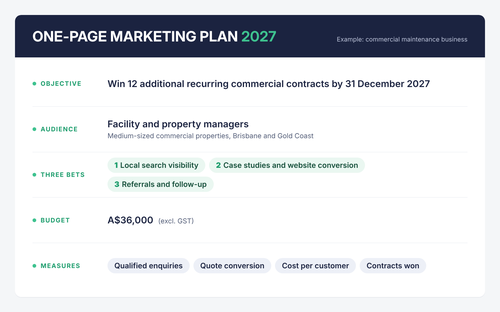
Let's bring the five parts together using our commercial maintenance example.
The business objective is to win 12 additional recurring commercial contracts by 31 December 2027. Its priority audience is facility managers and property managers responsible for medium-sized commercial properties in Brisbane and the Gold Coast.
Its three marketing bets are improving local search visibility to capture existing demand, publishing customer case studies and improving website conversion to build trust, and developing a more consistent referral and customer follow-up process.
The annual marketing budget is A$36,000 excluding GST, allocated across paid search, SEO, website improvements, content, customer relationship activity and specialist support.
Success will be measured through qualified enquiries, quote conversion, customer acquisition cost and, ultimately, the number of additional recurring contracts secured.
A marketing plan shouldn't be written in December and left untouched until the following year.
Markets change, competitors adjust their offers, customer behaviour shifts and sometimes the business itself develops new priorities. A plan needs enough structure to maintain focus but enough flexibility to respond to what is happening.
One approach is to keep the overall 2027 objective in place while working in 90-day blocks.
The first quarter might focus on getting the foundations right, including tracking, website improvements and campaign setup. The second quarter could concentrate on improving the activities that generate the strongest enquiries. The third might introduce a new campaign or expand into a priority customer segment. The final quarter could focus on retention, referrals and preparing the following year's strategy.
These are planning examples, not a fixed schedule. The actual sequence should reflect the business's sales cycle and seasonal demand.
Cemoh's Marketing Transformation Through Fractional Leadership case study provides a good example of what can happen when marketing activities lack a shared direction.
The client was a national recruitment and workforce solutions group operating several independent businesses across Australia. Each subsidiary was managing its own marketing, which resulted in duplicated work, inconsistent messaging and fragmented campaign activity.
The business needed more than additional social media posts or another advertising campaign. It needed a coordinated marketing function that could support candidate attraction and align activity across the group.
Cemoh brought in a fractional Chief Marketing Officer and a fractional Digital Marketing Manager. They introduced shared processes, standardised resources and consistent messaging while creating a marketing roadmap aligned with the group's business objectives.
Within the first six months, the organisation saw improvements in campaign efficiency, brand alignment and collaboration across its businesses.
The engagement was initially expected to last three to six months but continued for more than two years. Eventually, the group transitioned to an internal marketing team using the strategy and systems established during the engagement.
What it shows is how coordinated priorities, clear ownership and consistent processes can make marketing more effective across a complex organisation.
For a smaller business, the same principle applies. You don't necessarily need more marketing activity. You need to make sure the activity you invest in is working towards the same business objective.
Not every business has someone internally who can develop a marketing plan, assess the available data and decide which activities deserve investment.
Sometimes the owner is making marketing decisions without enough information. In other cases, the business has a marketing coordinator or specialist who can execute campaigns but needs more senior strategic direction.
An experienced marketing consultant can review the existing activity, identify opportunities and develop a practical plan based on the business's objectives and budget. If the business needs someone to take responsibility for the wider marketing function, a fractional CMO may be a better fit.
If the main challenge is execution, businesses can also hire a marketer through Cemoh to bring in the skills needed for specific activities.
A good marketing plan for 2027 isn't about predicting every opportunity or filling a calendar with campaigns. It's about making a few important decisions and giving the business a realistic way to act on them.
If you only do one thing before January, write down the single business result marketing needs to deliver in 2027. The audience, the three bets, the budget and the measures all follow from that.
Then keep the plan somewhere people can actually find it. Review it monthly, reconsider the priorities every quarter and be willing to stop activities that aren't delivering.
A one-page plan won't solve every marketing problem. But it can make sure everyone knows what the business is trying to achieve, where the money is going and what needs to happen next.
For most SMEs, that's a much better starting point than another 30-page marketing document that nobody opens after January.
Need help putting your 2027 plan together? Cemoh can connect you with an experienced marketing consultant or fractional CMO who can review what's working and help you decide where to focus. Find a marketing expert.
Here are some suggested articles that are closely related to this post
Not sure what a marketing consultant actually does? See how they audit, plan and roll out your marketing in the first 90 days, and what affects the cost.

What is digital marketing consulting and how does it work? We explain what a consultant does, why you need one, and how to hire the right partner in Australia.

Finally, a practical marketing strategy for small business owners in Australia. No jargon, just real-world advice to help you connect with customers and grow.

Tired of marketing plans that just gather dust? Learn how to create a marketing plan with actionable strategies and real-world advice to drive growth.

The client onboarding questions marketing consultants should ask about goals, budget, decision-makers and past agencies before the first piece of work starts.

Learn what is growth marketing with our practical guide to mindset, strategies, and experiments that drive real, sustainable business growth.