Unpacking the Cost to Advertise on Facebook
What's the real cost to advertise on Facebook in Australia? We break down the key factors, average costs, and how to set a budget that actually works.
03 Dec 2025
Explore how much does it cost for facebook ads for Australian businesses, with budgeting ranges, ROI tips, and practical steps to start today.
Blog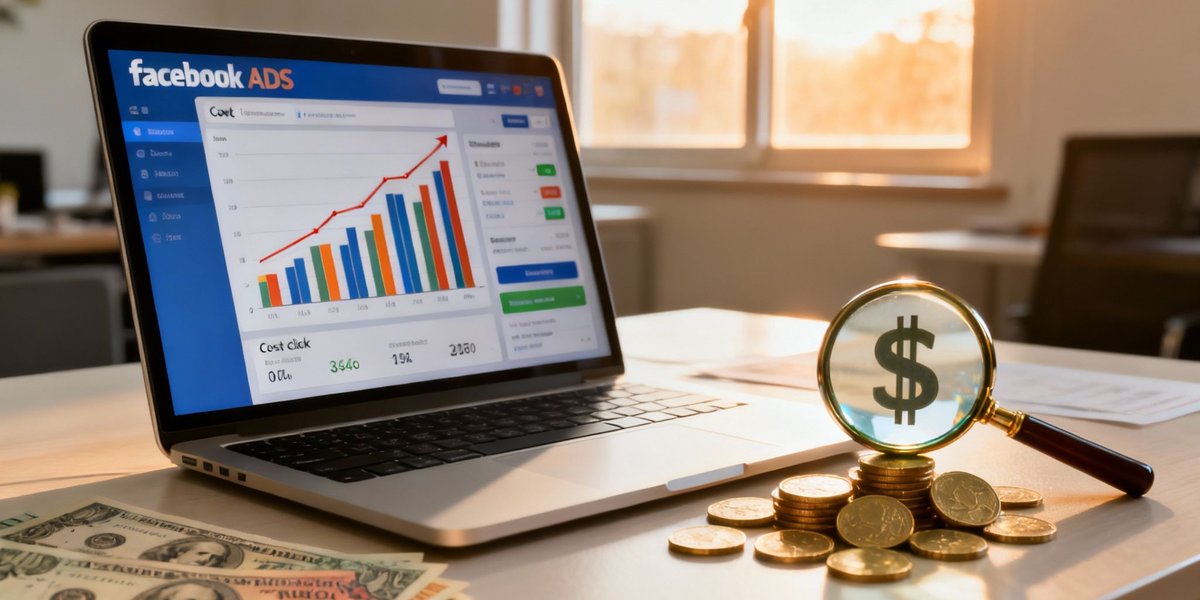
So, how much should you set aside for Facebook ads? Let's cut straight to the chase. For most Aussie businesses, you're looking at a Cost Per Click (CPC) somewhere between $0.50 and $2.00, and a Cost Per Thousand Impressions (CPM) of around $10 to $15.
That’s the quick and dirty answer.
But the reality is a little messier. Think of it as your starting point, not the final destination.
Okay, let's talk about the real frustration here. You just want a number. A simple figure you can plug into your budget spreadsheet and move on with your day. I get it. I’ve been there, staring at the Ads Manager, just wishing it would give me a straight answer for once.
But asking "how much are Facebook ads?" is a lot like asking "how much is a car?". You could get a reliable second-hand runabout to get you from A to B for a few grand. Or you could drop a fortune on a brand new luxury SUV with all the bells and whistles.
Facebook advertising works exactly the same way. There isn't one fixed price. It’s a massive, live auction where you’re bidding against thousands of other businesses for the same eyeballs. It’s dynamic. It’s always moving.
The final cost comes down to a few key things:
Let's ground this with some real-world data for Australia. Here’s a quick snapshot of what you can typically expect to pay.
For most local advertisers, the typical Cost Per Click sits somewhere between AUD $0.50 and AUD $2.00. Simple enough. At the same time, the Cost Per Thousand Impressions (the cost to get your ad seen 1,000 times) is generally AUD $10 to AUD $15.
But if you're in a super competitive niche, like beauty or finance, that CPM can skyrocket to as high as AUD $80. It just shows how much your industry impacts the price you'll pay, and you can explore more 2025 benchmarks to get a deeper understanding of where you might fit.
The honest truth is that your budget is a direct reflection of your ambition and your industry. The price isn't set in stone... it's a living number that you can influence with smart strategy, great creative, and precise targeting.
This section is just to give you a feel for the numbers. A quick look under the bonnet before we really get into the nuts and bolts of what drives the price up… or brings it down. Think of it as your orientation. We'll explore the 'why' behind these costs next.
When you tip your money into the big Facebook machine, what are you actually buying? It can feel a bit like a mystery box, can’t it? You’re not just paying for your ad to randomly pop up on someone's screen.
You’re paying for a specific outcome. An action. A result.
Think of it like ordering at a restaurant. You don't just walk in and say "give me food." You pick a specific dish from the menu based on what you’re in the mood for, don't you? Facebook's 'menu' works the same way, and if you order the wrong thing, you’ll end up feeling unsatisfied and a bit ripped off.
Let's break down the main 'dishes' you can order.
First up is CPM, which stands for Cost Per Mille. 'Mille' is just a fancy French word for one thousand. So, with CPM, you're paying a set price for every 1,000 times your ad gets shown to someone.
This is the digital equivalent of putting a billboard up on the M1. You're paying for pure, simple exposure. You don't pay more if people stare at it, take a photo, or decide to visit your shop because of it. You just pay for the eyeballs... or at least, the opportunity for eyeballs.
This model is your best friend if your main goal is brand awareness. Maybe you're a new cafe in town and you just want everyone in the suburb to know you exist. You’re not asking them to do anything right now; you just want your name to start popping into their heads when they think "coffee". For this, CPM is perfect. It’s often the cheapest way to get your ad seen by a massive number of people.
It's all about reach. You're casting a wide net to build recognition, not trying to get someone to buy something this very second. The goal is simply to become familiar.
Next on the menu is CPC, or Cost Per Click. This one is pretty straightforward: you only pay when someone is interested enough in your ad to actually click on it.
They saw your ad, they read it, and they thought, "Hmm, I want to know more." Click. And only then… does Facebook take your money.
This is a big step up from just paying for eyeballs. You're now paying for genuine interest. Someone has effectively raised their hand to show they’re curious. This model is brilliant when you want to drive traffic to your website, a specific landing page, or a blog post. You want people to leave the Facebook ecosystem and come over to your turf to learn more.
Let’s put it this way:
It’s more expensive per action than just showing the ad, of course, but the quality of that interaction is so much higher. You're no longer just a billboard; you're starting a conversation.
Finally, we get to the big one: CPA, which means Cost Per Action or Cost Per Acquisition. This is where you only pay when someone takes a very specific, valuable action that you've defined ahead of time.
This 'action' is the entire reason you're advertising in the first place. It could be making a purchase, filling out a lead form, signing up for your newsletter, or booking a consultation. It's the ultimate prize.
You're effectively telling Facebook, "I don't care how many people see my ad, and I don't even really care how many click it. I will only pay you when I get the result I actually want."
Naturally, this is the most expensive of the three models. But it's also the most directly tied to your return on investment. If you sell a product for $100 and your CPA is $20, you know you're making a profit on every single conversion. It strips away a lot of the guesswork.
This is the model you use when your goal is crystal clear. You want sales. You want leads. You want bottom-line results, and you're willing to pay a premium to get them.
Ever look at another business and wonder how on earth their ads seem to be everywhere? Or maybe your friend, the one who sells handmade pottery, mentioned her ad costs are half of what you’re paying for your accounting firm. It feels random. Unfair, even.
But it's not. I promise.
Think of the Facebook ad auction less like a fixed-price shop and more like a real-world auction for a house in a hot suburb. The final price isn't just about the house itself. It's about who else is bidding, what time of year it is, and how badly everyone wants that specific property. Your Facebook ad costs work the exact same way.
Let’s pull back the curtain on the big levers that secretly control what you pay. Understanding these is your secret weapon.
First up, and this is a big one, is who you're trying to talk to.
Imagine you’re trying to get the attention of CEOs in the Sydney CBD. That’s prime real estate. You're competing with luxury car brands, high-end financial services, and B2B software companies with massive budgets. The cost to get in front of that audience is going to be high.
Now, imagine you're targeting uni students nationwide who are interested in sustainable fashion. It's still a valuable audience, but it's much broader and likely less competitive. The cost for that click will almost certainly be lower.
The more valuable your audience is to other advertisers, the more you'll have to pay to reach them. It's a simple case of supply and demand for their attention.
Your industry plays a huge part here, too. Fields like legal services, finance, and real estate are notoriously expensive because a single new client can be worth thousands of dollars. Businesses in these areas are willing to pay a lot more for a lead, which drives up the auction price for everyone.
Have you ever noticed how your ad costs seem to shoot up around November? You’re not imagining things.
Advertising costs can spike dramatically around major commercial events. Think Christmas, Black Friday, Cyber Monday, Valentine's Day... any time when basically every retailer on the planet is trying to get in front of shoppers. More competition means higher bids, and higher bids mean you pay more.
This is a totally normal part of the advertising cycle. Recent data on the Australian market showed just how much costs can swing. Analysing CPM trends, one report found that while the median CPM in Australia was around AUD $15.60, it could dip as low as AUD $13.09 in a quiet month like February. But by the time the pre-Christmas rush hit in November, it had surged a massive 82% to a peak of AUD $23.86. You can dive deeper into these year-round cost fluctuations on Superads.ai to see the trends for yourself.
This is why smart advertisers often pull back their spending a little during the absolute peak seasons or focus their budget on quieter, less competitive periods. Smart, not cheap.
Okay, this last one is the most important factor because it’s the one you have the most control over. Facebook actually rewards you for making good ads.
Meta gives your ads a 'quality score' behind the scenes. It's not a single number you can see, but it’s based on things like:
This infographic breaks down the core pricing models you'll encounter.
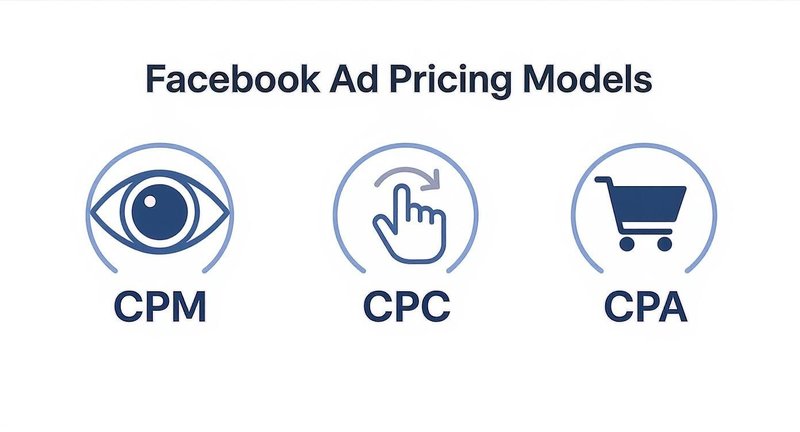
This shows that you can pay for eyeballs (CPM), clicks (CPC), or conversions (CPA), but your ad quality influences the cost for all of them.
If Facebook sees that people genuinely like your ad, it will show it to more people for less money. Why? Because Facebook’s primary goal is to keep users happy and scrolling on their platform. Good ads contribute to a good user experience; bad, spammy ads do the opposite.
I once worked with a client whose CPC was stubbornly high. We didn't change the audience or the budget. All we did was swap their generic stock photo for an authentic, behind-the-scenes video of their team. Their costs dropped by over 40% almost overnight.
That’s the power of making something people actually want to see. You literally get rewarded for not being boring.
Theory is great, but let's get down to brass tacks. Real money. Real businesses. What does a ‘small’ or ‘medium’ budget actually look like for an Australian business just trying to get ahead? It’s a question I hear all the time, and the vague answers out there are seriously frustrating.
So let’s map out some practical scenarios. Forget jargon and complex formulas for a minute.
Imagine you're running a local cafe in Melbourne. Your goal is simple: sell more morning coffees and maybe get a few more people in for lunch. Or maybe you're an e-commerce store based out of Byron Bay, pouring your heart into handmade jewellery and needing to find customers beyond the local markets.
This is where the rubber meets the road. What can you realistically expect for your money?
Let's start with a common entry point for many small businesses: $500 a month. That's about $16-$17 a day.
What does that buy you? It buys you data. It buys you learning. At this level, your primary goal isn't to get a flood of sales on day one. It's to figure out what works.
With $500 a month, you can start to:
This isn't about setting the world on fire. It's about lighting the first match and seeing which direction the wind is blowing. It's your reconnaissance mission. To get a feel for how to get started, check out our guide on how to set up a Meta ad campaign which walks you through the initial steps.
Okay, so things are going well. You’ve run your initial tests, you've found a couple of ad styles that work, and you know who your most responsive audience is. It's time to pour a bit more fuel on the fire.
When you move into the $2,000 to $5,000 a month range, the game changes. A bigger budget doesn't just mean doing more of the same; it unlocks completely new, more powerful strategies.
You’re no longer just testing the waters. You’re starting to build a predictable, scalable marketing machine.
At this level, you shift from finding what works to scaling what works. Your budget is now big enough to feed Facebook's algorithm the serious data it needs to find your perfect customer, again and again.
With this kind of budget, you can get serious about things like:
The takeaway here is that your budget dictates your strategy. A small budget is for learning and validating. A medium budget is for scaling and optimising. Don't try to run a scaling strategy on a learning budget… it's like trying to win a Grand Prix in a go-kart.
Start small, prove your concept, and then confidently invest more once you know what's delivering a return. That’s how you build a profitable advertising engine without just burning through cash.
Right, let's get into the part everyone's been waiting for. How do you get more bang for your buck with Facebook Ads? It’s not about being cheap; it’s about being smart.
The goal isn't just to slash your spend. It's to make every single dollar you invest work harder and go further. The good news? It's entirely possible. You just need to focus on a few key areas.
The single fastest way to burn through your budget on Facebook is by showing your ads to the wrong people. It’s like putting up a poster for a vegan cafe inside a butcher's shop. A complete mismatch, and a total waste of money.
You need to get specific. Really specific.
Instead of targeting a massive group like "women in Australia," you need to narrow it down. Think more along the lines of "women aged 30-45 in inner-city Melbourne who have shown an interest in yoga and organic food." See the difference? One is a wild guess; the other is an educated move.
Getting laser-focused with your targeting is the quickest path to lower costs. You're essentially telling Facebook, "Don't waste my money on tyre-kickers; find me these exact people." A smaller, more relevant audience will always outperform a huge, generic one.
When your ad is highly relevant to the audience seeing it, Facebook's algorithm actually rewards you with lower costs. It’s that simple. To get this right from the start, it's worth consulting a simple guide to Facebook Ads for local business owners that focuses on this kind of efficiency.
Your ad creative—that's your image, your video, and the words you write—is your frontline soldier. It has one critical job: to stop someone from mindlessly scrolling through their feed.
If your ad is boring, you'll pay for it. Literally.
People often forget that Facebook is a social platform first and foremost. They're there to see photos of their friend's new puppy, not your sales pitch. Your ad needs to earn its place in their feed by being interesting, helpful, or entertaining.
Here are a few things that work wonders:
Okay, this is my personal favourite tip because it’s incredibly powerful and so cost-effective. Retargeting is like having a second conversation with people who have already shown they’re interested.
Think about it. Someone has visited your website, maybe they even added a product to their cart, but then life happened and they got distracted. They already know who you are. They're a warm lead!
It is so much cheaper to get that person to come back and finish their purchase than it is to find a brand new customer from scratch. You can set up specific ads that only show to people who have recently visited your site or engaged with your page.
These campaigns almost always deliver the highest return on investment because you’re not starting the conversation from zero. You're just gently reminding them why they were interested in the first place. If you're keen to dig deeper, our article on mastering Facebook ads provides more detailed strategies for both targeting and ad writing.
At some point, you’re going to hit a wall with your ads and wonder if it’s time to call in the cavalry. I get it. Juggling Facebook ads can feel like a full-time job, and it’s just painful when you’re pouring money into something that isn’t working.
So, when does DIY stop making sense and hiring a pro become the smart move?
It usually boils down to one of two things. Either you're spending a decent amount of cash—maybe over $1,000 a month—but the results just aren't there. Or you simply don't have the hours in the day to dive deep into Ads Manager and figure out why.
Think about where you’re at right now. Do any of these hit a little too close to home?
If you're nodding along, it’s probably time to consider getting an expert involved. This isn’t about admitting defeat; it’s a strategic business decision, just like hiring an accountant to do your taxes. A good marketer can often save you money in the long run by eliminating wasted ad spend. Before you even speak to someone, you can get a clearer picture by understanding what to expect from a PPC audit and what it can reveal about your account.
Bringing in a professional isn't an expense; it's an investment in efficiency. You're buying back your time and swapping guesswork for proven expertise, which is often the fastest path to seeing a real return.
Of course, hiring an expert comes with its own costs. If you're weighing up the pros and cons, it's helpful to understand how much marketers typically earn for their services. This context can help you figure out what a realistic budget for a freelancer or agency might look like, helping you make the right choice for where your business is at.
Alright, let's get into the questions that are probably buzzing around your head right about now. I hear these all the time from business owners trying to get their heads around Facebook Ads.
No jargon, just straight-up, practical answers.
Honestly, for most small Australian businesses, a great place to kick things off is around $20 to $25 per day. I know, that might not sound like a huge number, but starting small is the smart play here.
This gives the Facebook algorithm just enough fuel to start learning about your audience and optimising your ads, all without you having to bet the farm. It's the perfect amount to test the waters, see what's resonating, and then confidently scale up once you've found a winner. It’s always better to start focused than to throw a big budget at a bunch of untested ideas.
This is the hard part. Patience is a virtue in the world of digital ads, and it feels like an eternity when it's your own money on the line. You absolutely have to give the algorithm time to do its thing… a period Facebook calls the ‘learning phase’.
A solid rule of thumb is to let a brand-new campaign run for at least 3 to 5 days before you even think about touching it. This gives the algorithm enough time to exit that initial learning phase and for performance to stabilise. Only then will you get a clear picture of your real-world costs and results. Please, resist the temptation to pull the plug after one expensive day!
Not necessarily, but they will definitely fluctuate. That’s just the nature of the auction. Costs can creep up if your audience starts getting ‘ad fatigue,’ which is a fancy way of saying they’re sick of seeing your ad. Think of it like a new song on the radio; the first few times you hear it, it’s great. After the hundredth time? You're reaching for the dial.
Costs can also spike during busy retail seasons (like Christmas) or if a bunch of new competitors suddenly jump into your space. But here's the good news. If you're actively managing your campaigns by refreshing your creative, testing new audiences, and optimising your strategy, you can often keep your costs stable or even bring them down as you get smarter.
Feeling like you'd rather have an expert handle all this? We get it. Cemoh connects you with the top 1% of pre-vetted marketing talent in Australia, from freelance specialists to fractional CMOs. Find the right fit for your business and budget at https://cemoh.com.
Here are some suggested articles that are closely related to this post
What's the real cost to advertise on Facebook in Australia? We break down the key factors, average costs, and how to set a budget that actually works.

Tired of marketing plans that just gather dust? Learn how to create a marketing plan with actionable strategies and real-world advice to drive growth.

What is digital marketing consulting and how does it work? We explain what a consultant does, why you need one, and how to hire the right partner in Australia.

Thinking about hiring a Google Ads consultant? Learn how a real expert can boost your ROI, what to look for, and how to avoid the time-wasters.

Finally, a practical marketing strategy for small business owners in Australia. No jargon, just real-world advice to help you connect with customers and grow.

Need a marketing consultant for small business? Discover expert tips and guidance to boost your small business marketing success today.